

.png)
.png)


What Does NAD+ Do for Your Body?
Read post

Your biological age isn't fixed. Here's what actually impacts it.
Your biological age (how old your cells actually behave) doesn't have to match up with your birthday. Research now shows that specific, measurable interventions can reverse biological aging markers, not just slow them down. So yes, it is possible to reduce your biological age. But how?
The biggest levers: consistent exercise, quality sleep, anti-inflammatory diets, and shoring up NAD+ levels as they naturally decline with age.
Here's what the science actually says about turning the cellular clock and reducing biological age.
Chronological age is just how long you've been alive. Biological age reflects how your cells, tissues, and organs are actually holding up over time—and the two can diverge by a decade or more in either direction. Someone with a biological age ten years younger than their real age isn't just lucky. They likely have cells that replicate more accurately, repair DNA faster, and carry less inflammatory damage.
This gap is the whole premise of longevity medicine, the clinical field focused on extending healthspan (the years you actually feel good) rather than just lifespan. Longevity medicine treats biological aging as something modifiable, not fixed. That's a meaningful shift from how medicine has traditionally approached it.
The most validated tool is the epigenetic clock — a method that reads biological age by analyzing DNA methylation patterns (chemical tags on your DNA that shift predictably as you age). The Horvath and GrimAge clocks are the most cited versions, and both predict disease risk more accurately than chronological age alone.
Other markers longevity medicine tracks:
That last one matters. Sirtuins show up across almost every aging marker, and they run on NAD+, which is why NAD+ has become one of the most watched targets in longevity medicine. More on that in a minute.
In the same way we want our skin to look our age (or better), we want our cells acting their age (or better). There's nothing worse than feeling like you may have the cells of someone twice your age.
Some of this is genetic—certain people simply have more efficient DNA repair mechanisms or slower telomere attrition. But genetics accounts for roughly 25% of how you age. The rest is modifiable.
In terms of what causes acceleration a few mechanisms are well-established:
Here's the honest ranking. The interventions with the most evidence behind them, what they do, and how big a difference they can realistically make:
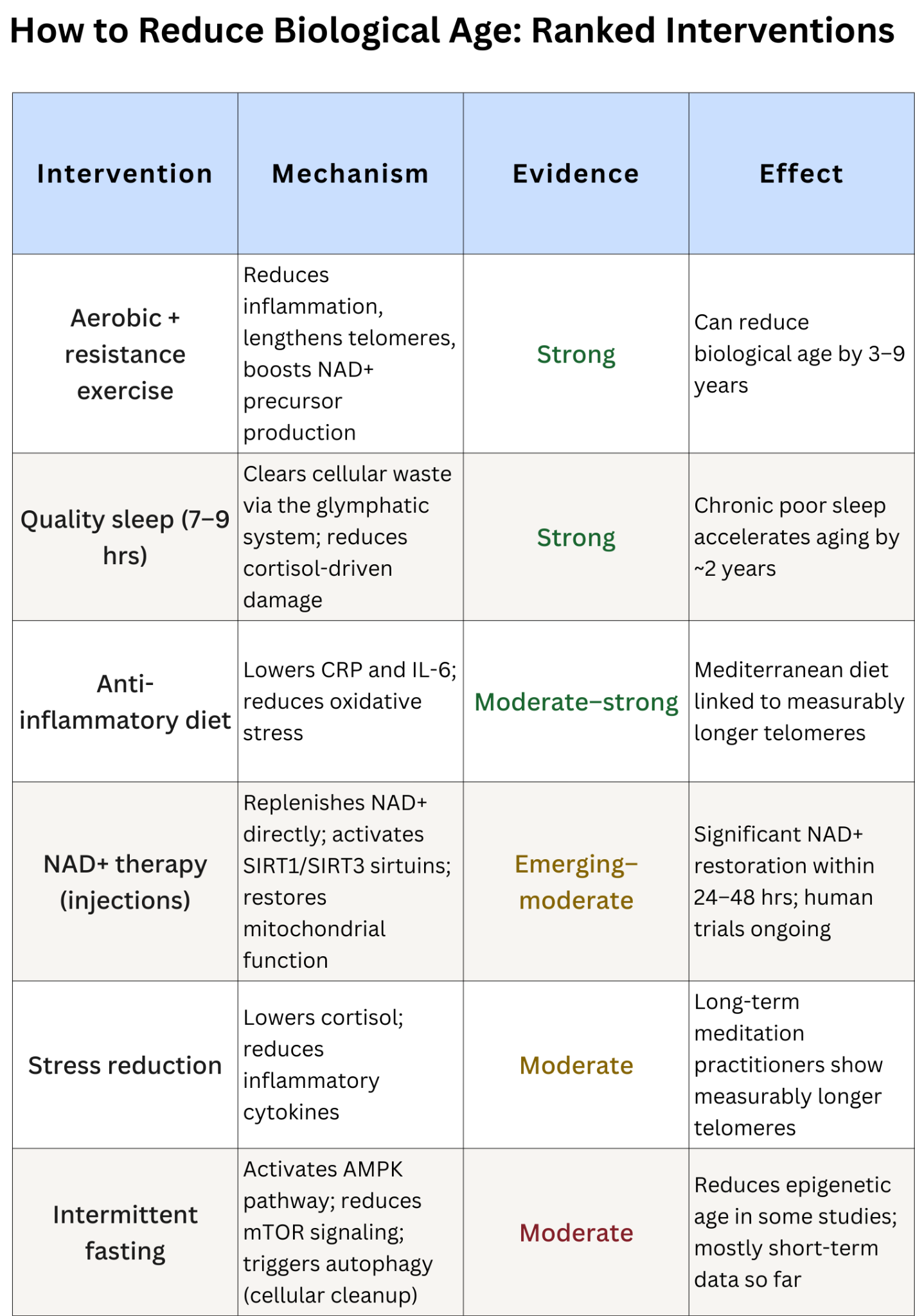
So how to truly reduce biological age yourself? A 2021 study in the Aging medical journal found that a multi-modal protocol combining diet, exercise, sleep, and stress work reduced epigenetic age by an average of 3.23 years in just 8 weeks. That's from lifestyle changes alone, no injections, no prescriptions.
NAD keeps showing up in longevity research because it's genuinely central to how well your cells repair themselves, and it falls off a cliff as you age.
Here's the actual mechanism: NAD+ is required to activate sirtuins, specifically SIRT1 and SIRT3, proteins that regulate inflammation, mitochondrial health, and DNA repair. When NAD+ is low, sirtuin activity drops. DNA repair slows. Mitochondria get less efficient. Cells accumulate damage faster than they can fix it.
NAD+ also powers PARP enzymes (which detect and patch single-strand DNA breaks). You can think of PARP as your cellular maintenance crew. When NAD+ is depleted, the crew is working with no tools.
Research from the NIH's National Institute on Aging shows that restoring NAD+ in animal models reverses several aging-related declines in muscle, metabolic health, and cognition.
For most people, yes—and it comes down to how your body actually absorbs them.
Oral NAD+ precursors like NMN and NR (nicotinamide riboside) have to survive digestion, absorb through your gut wall, and then get converted into NAD+ through a multi-step enzymatic process. Bioavailability varies a lot between products and between people. Some folks respond well. Others don't notice much at all.
NAD+ injections go directly into circulation. No digestion, no conversion pathway. Blood NAD+ levels rise measurably within 24–48 hours. If you've been taking oral supplements and wondering if they're actually doing anything, injections give you a more predictable answer.
Strut's NAD+ therapy pairs injections with guidance from a licensed provider, so you're working with someone who can actually dial in your dosing and frequency rather than just guessing at it based on what's on the label.
Can you actually reverse biological age, or just slow it down?
Both, based on the research. Epigenetic clock studies have shown genuine reductions in biological age, not just a slower climb, with comprehensive lifestyle interventions. Think of it less like turning back a clock and more like clearing a backlog: when you reduce what's stressing your cells and give them the raw materials to repair, they start functioning more like younger cells.
How long does it take to see a change in biological age?
The 2023 Aging Cell study above showed meaningful epigenetic age reduction in 8 weeks. That said, most people aren't testing epigenetic clocks regularly. The more practical things to track are energy levels, sleep quality, recovery speed, and inflammatory markers like CRP and fasting insulin — all of which can shift within weeks of consistent lifestyle changes.
What exactly does NAD+ do in the context of longevity medicine?
NAD+ is the fuel for two of your body's main aging-defense systems: PARP enzymes (DNA repair) and sirtuins (cellular aging regulation). When NAD+ is adequate, both systems run at capacity. When it's low — the default from your 40s on — both slow down and cellular damage accumulates faster than it gets fixed. Restoring NAD+ doesn't replace good sleep and exercise, but it gives your cellular machinery better fuel to work with.
Is NAD+ therapy safe?
NAD+ has a well-established safety profile. IV administration can cause flushing or nausea if the rate is too fast, which is why method and dosing matter. Subcutaneous injections tend to be better tolerated. Working with a licensed provider, the way Strut Health’s program is set up, means the protocol is built around you, not a one-size number.
What's the single most important thing someone can do to lower their biological age?
Exercise, and specifically a combination of aerobic training and resistance work. The evidence is stronger here than for any single other intervention. It lowers inflammatory markers, lengthens telomeres, boosts NAD+ precursor production, and improves mitochondrial density. Sleep, diet, and NAD+ support all compound on that foundation — but if you're only doing one thing, make it this.
Do NAD+ supplements work the same as injections?
Not with the same reliability. Oral precursors like NMN and NR raise NAD+ in many people and there's real evidence for them. But absorption varies, the conversion pathway has multiple steps, and the supplement market is inconsistent in quality. Injections deliver NAD+ directly into circulation with predictable results. If oral supplements haven't been doing much for you, or you want a more clinically controlled approach, injections are the more direct route.
Turns out, how fast you age is largely up to you and your lifestyle. The research is clear that exercise, sleep, and managing inflammation do the heavy lifting—and that NAD+ is one of the more compelling tools to support what your body is already trying to do. None of this requires an overhaul. It requires consistency, and occasionally, the right clinical support.
If compounded, off-label NAD+ therapy is something you want to explore for longevity, Strut makes it straightforward. See if you're a candidate.


.png)