

.png)
.png)

How to Purchase Vardenafil Online Safely
Read post

Can dehydration cause erectile dysfunction? Maybe, but probably not in the way you're hoping.
Dehydration can temporarily make it harder to get or maintain an erection. That part is true.
But if ED troubles keep happening in your day-to-day, dehydration almost certainly isn't the real cause. Perhaps it’s a contributor, at most, not an explanation.
This matters because a lot of men Google "can dehydration cause ED" looking for a simple fix. Drink more water, problem solved. And while hydration does support erectile function, persistent ED points to something else—something treatable, but, unfortunately not with a glass of water.
Yes, dehydration can contribute to erectile difficulties—temporarily. When your body is low on fluids, blood volume drops. Circulation becomes less efficient. And since erections depend heavily on blood flow to the penis, that matters.
Occasional difficulty after a long day in the sun or a night of heavy drinking is one thing. Ongoing ED that keeps showing up? That's rarely about hydration.
An erection is a hydraulic event. Arousal triggers your brain to send signals through your nervous system, telling blood vessels in the penis to relax and fill. Blood flows in, gets trapped in the erectile tissue, and stays there long enough to maintain firmness.
Dehydration works against this—and it doesn't take much.
Research shows that even 24 hours of low fluid intake is enough to activate your sympathetic nervous system and raise levels of angiotensin, a hormone that constricts blood vessels. Skipping water for a day, drinking too much coffee, sweating through a hot afternoon—that's all it takes to reduce blood flow throughout your body, including where it matters most.
Then there's the mental side. Mild dehydration causes fatigue, irritability, and brain fog. None of that helps with arousal.
So yes, staying hydrated supports erectile function.
Think of water like oil in an engine. You don't wait until the car breaks down to check it—you maintain it so everything keeps running smoothly. The same principle applies here.
The easiest way to check your hydration? Look at your urine. Pale yellow or clear means you're good. Dark yellow or amber means you're behind. If it looks like apple juice, you need water now.
Other signs of mild dehydration include thirst (obviously), dry mouth, fatigue, headaches, and brain fog. By the time you feel thirsty, you're already slightly dehydrated—so don't wait for that signal.
As for how much to drink: the National Academy of Medicine recommends about 13 cups (around 3 liters) of total fluids per day for men. Coffee and tea count, though water is still the best choice.
If you're active, sweating, drinking alcohol, or spending time in the heat, you need even more.
If you're drinking enough water—or if erectile issues are happening more often than they used to—something else is likely going on.
Even if you're mildly dehydrated, like most of us are, it's unlikely to affect your erections consistently. Consistency is the clue. That's when it's worth looking deeper.
Erectile dysfunction affects a significant portion of men, particularly as they age.
Studies suggest around 50% of men between 40 and 70 experience some degree of ED. It's one of the most common sexual health concerns men bring to their doctors. You're not an outlier.
Vascular issues are the most common. The same factors that lead to cardiovascular disease—high blood pressure, high cholesterol, venous insufficiency—also affect blood flow to the penis. In fact, ED is often an early warning sign of broader circulatory problems. The arteries supplying the penis are smaller than coronary arteries, so they tend to show problems first.
Psychological contributors are more common than many men realize. Stress, anxiety, depression, relationship issues, performance pressure—all of these can interfere with arousal. And once you've had a few experiences of ED, the anxiety about it happening again can become its own cause. It's a loop that's hard to break without addressing both the mental and physical sides.
Medications are another frequent culprit. Blood pressure drugs, antidepressants, antihistamines, and various other prescriptions can affect erectile function as a side effect.
Hormonal changes play a role in some cases. Testosterone naturally declines with age, and while low testosterone alone rarely causes ED, it can reduce desire and make erections harder to achieve.
Neurological factors matter too. Erections require signals traveling from the brain through the spinal cord to the nerves around the penis. Conditions like diabetes, multiple sclerosis, or spinal injuries can interfere with that signaling.
The point here isn't to self-diagnose, it's to understand that if ED is recurring, the explanation is almost certainly more complex than hydration status.
ED Treatments That May Actually Work For You
ED is highly treatable and your options for treatment are evolving fast. The most recent compounded innovation in the space is the ease and quick acting formulas in ED mints containing classic and off-label prescription ingredients for ED.
There are many options in general, some new, some long-standing, but most men find something that works for them.
PDE5 inhibitors remain the gold standard for first-line treatment. These medications—sildenafil, tadalafil, vardenafil, avanafil—work by relaxing smooth muscle in penile blood vessels and improved blood flow during arousal.
Each one has a slightly different profile.
Sildenafil and vardenafil act relatively quickly (within 30-60 minutes) and last 4-6 hours.
Tadalafil takes a bit longer to kick in but stays active for up to 36 hours, which many men prefer for the flexibility it offers.
Dopamine agonists, like apomorphine, are used off-label for sexual health and take a different approach. Instead of working on blood flow directly, they act on the brain—specifically the dopamine receptors in the hypothalamus that help initiate the arousal cascade. This can be particularly useful for men whose ED has a psychological component or who don't respond well to PDE5 inhibitors alone.
These different pathways matter because ED is rarely a single-point failure. Blood flow is part of it. Brain signaling is part of it. Hormones, nerves, and psychology all contribute. Treatments that address multiple pathways tend to produce better outcomes.
If erectile difficulties are happening regularly—say, more than half the time you attempt sex—it's worth having a conversation with a healthcare provider.
A provider can help identify any underlying factors, rule out medication interactions, and recommend a treatment approach matched to your situation.
Strut Health offers fast, discreet online consultations for FDA-approved or off-label compounded options, if you'd rather skip the waiting room. You can connect with a licensed provider, discuss your symptoms, and—if appropriate—get a prescription shipped directly to you.
ED dissolvable mints are the easiest way to treat ED on the market right now.
If you're looking for something fast, discreet, and effective, ED mints are the newest evolution in treatment. No pills to swallow, no waiting around, no awkward pharmacy pickups.
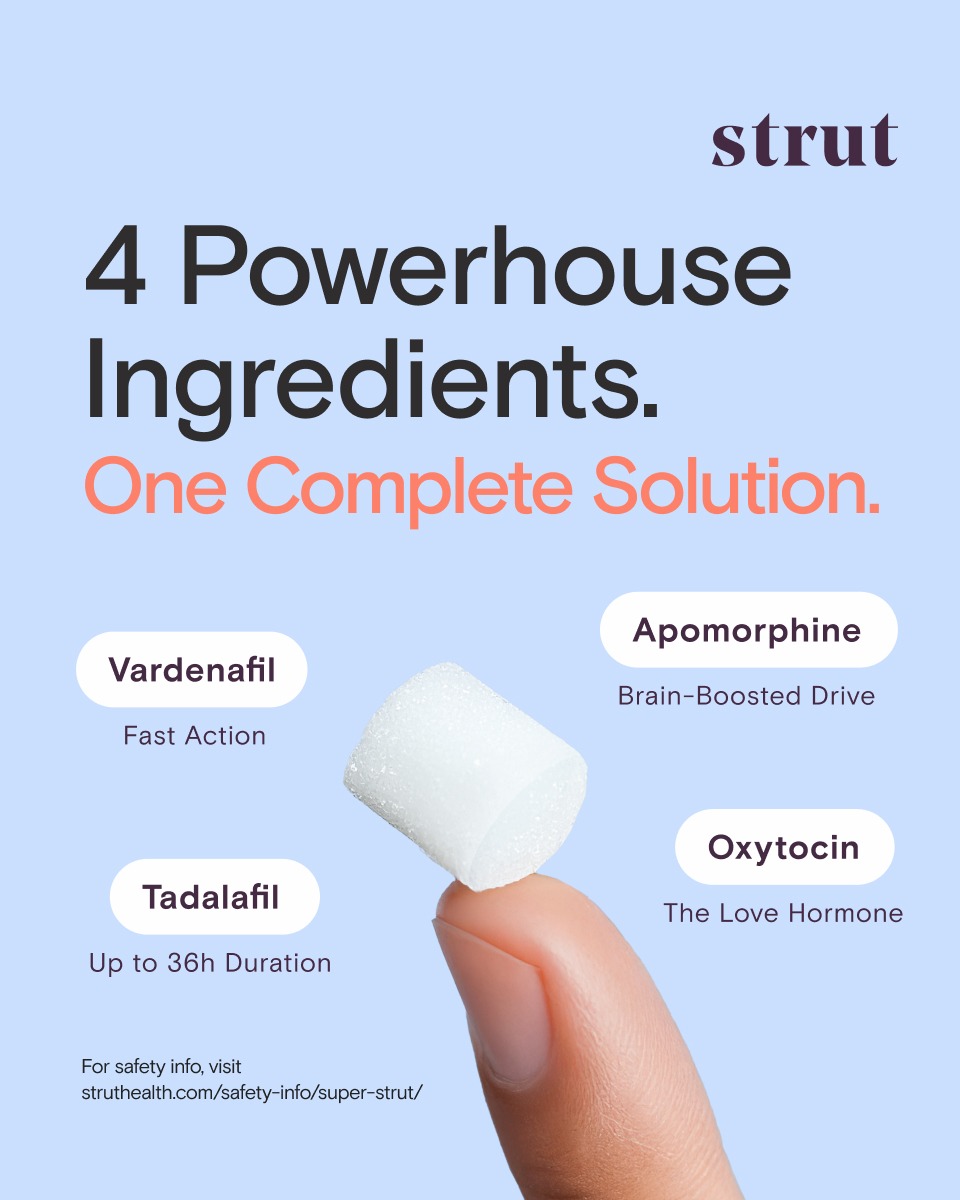
Super Strut is a dissolvable tablet that combines four active ingredients (Tadalafil, Vardenafil, Oxytocin, and Apomorphine) into one mint.
It works within minutes, lasts up to 36 hours, and fits in your pocket.
Can dehydration cause ED? Technically, yes, in the same way that being exhausted or stressed can temporarily affect your performance.
It's a factor, not usually the factor.
If you're experiencing ED consistently, the explanation is almost always more complex: vascular health, nerve function, hormones, psychology, medications, or some combination. And the good news is that effective treatment exists.
Staying hydrated is smart. So is eating well, exercising, managing stress, and getting enough sleep. But if those basics aren't resolving your symptoms, it's time to look at treatment options that actually target the mechanisms involved.
Either way, this is common, and it's often fixable.


.png)