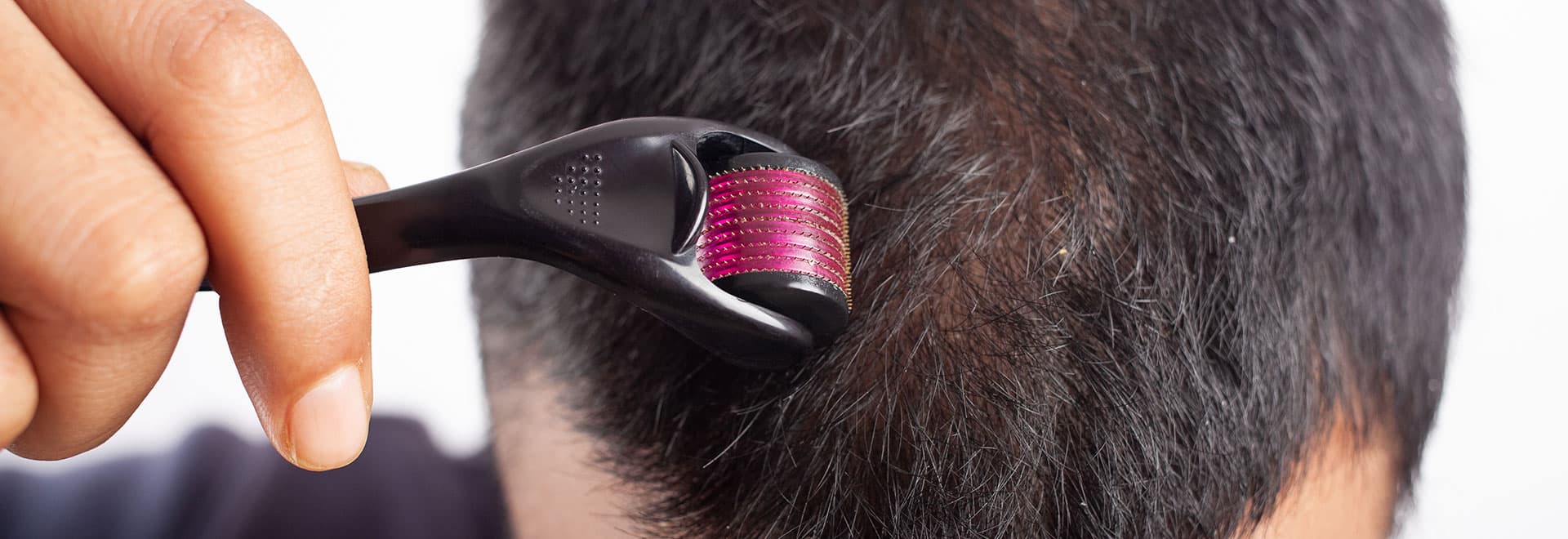
Minoxidil + Vitamins: Is It Actually Enough?

The logic seems airtight, minoxidil to stimulate growth, vitamins to fuel it. Easy. It's why combination products—gummies, chews, all-in-one formulas—have flooded the market. And these formulas do address two legitimate aspects of hair health and regrowth.
On this page
But there's just one problem.
These minoxidil and vitamin duos skip the very thing that's actually causing most hair loss to begin with.
What Minoxidil Actually Does
Minoxidil is a vasodilator. When applied to the scalp (or taken orally), minoxidil widens blood vessels and increases blood flow to hair follicles. This delivers more oxygen and nutrients to the follicular unit, which can nudge dormant follicles into the active growth phase.
Minoxidil also appears to extend the growth phase of the hair cycle while shortening the resting phase.
The result: thicker individual strands, more follicles actively producing hair at any given time, and visibly denser coverage over months of consistent use.
And it works, topical or oral forms. Clinical data backs this up repeatedly.
But while minoxidil is a growth stimulant and it pushes follicles to perform, it doesn't ask why they were struggling in the first place.
What Hair Vitamins Do (and Don't Do)
Hair is metabolically expensive tissue. Building keratin—the structural protein that makes up hair strands—requires amino acids, cofactors, and micronutrients. So the idea that vitamins support hair growth makes intuitive sense.
But, taking only vitamins to boost hair regrowth or fix hair loss, simply won't pan out.
If you're not deficient in these nutrients, supplementing them won't accelerate hair growth.
But when you're pushing follicles to work harder with a growth stimulant like minoxidil, ensuring adequate nutritional support is smart forward thinking.
Think of it as making sure the raw materials are available when the factory ramps up production. It's supportive care, helpful but not transformative.
Vitamins that may help:
The vitamins typically included in hair-focused formulas serve specific functions:
- Biotin acts as a cofactor in keratin production
- Zinc supports protein synthesis and cell division
- Vitamin D plays a role in follicle cycling
- Vitamin C aids iron absorption while contributing to collagen formation
- Folate and other B vitamins support the rapid cell turnover required for active hair growth
The Truth: Minoxidil + Vitamins Help, But They Don't Stop Hair Loss
Here's where the marketing story diverges from the REAL clinical reality.
The vast majority of hair loss is androgenetic alopecia, or pattern hair loss. It’s the most common cause of hair loss, affecting up to 85% of men and 40% of women. It's driven by hormones and genetics, not nutritional deficiency.
The mechanism is straightforward: testosterone converts to DHT → DHT binds to follicle receptors → follicles shrink → hair thins with each cycle → eventually, no hair is produced from damaged follicles.
If you’re dealing with this type of hair loss, minoxidil and vitamin duos might help to an extent. It’s definitely better than doing nothing…
But here's the medical limitation
Minoxidil can stimulate those follicles to perform better while they're still functional. Vitamins can ensure the building blocks are present.
But neither of them addresses the DHT that's causing the follicles to shrink in the first place. The stimulation helps but the underlying damage continues.
When this duo treatment works well: If you're dealing with temporary hair loss (called telogen effluvium) this treatment may help. But DHT-related hair loss? You’re missing a major aspect of treatment.
The Missing Piece: A DHT Blocker
If DHT is the problem, the logical solution is reducing DHT's impact on follicles. This is exactly what DHT blockers do.
The most studied DHT blocker is finasteride, a 5-alpha reductase inhibitor that reduces serum DHT levels by roughly 70%. By preventing the conversion of testosterone to DHT, finasteride protects susceptible follicles from the progressive miniaturization that causes pattern hair loss.
Dutasteride, a similar medication, blocks even more DHT, around 90%.
Some men also see some regrowth on finasteride alone.
While monotherapy clearly works, many dermatologists consider combination therapy the gold standard.
Research suggests that minoxidil plus finasteride may work better than either treatment alone.
What a Full-Stack Approach Looks Like: Minoxidil + Vitamins + DHT Blocker
Comprehensive hair loss treatment for androgenetic alopecia addresses three pathways simultaneously.
Stimulation: Oral or topical minoxidil to increase blood flow, extend the anagen phase, and push follicles into active growth.
Prevention: A DHT blocker like finasteride or dutasteride to protect follicles from ongoing miniaturization and stop the progression of loss.
Support: Bioavailable vitamins to ensure the nutritional cofactors for keratin production and follicle health are present, particularly useful when you're asking follicles to work overtime.
Compounded hair capsules contain minoxidil, a DHT blocker, and key hair vitamins in a single capsule for men and women. These ingredients may be used as part of a comprehensive approach to hair loss management.*
Safety Considerations
Minoxidil and DHT blockers like finasteride can cause side effects, so your prescriber will review the risks with you.
For finasteride, early studies showed sexual side effects (changes in libido, erectile function) in roughly 2% of users. Side effects may continue after stopping in some people, so report any changes to your prescriber.
Oral minoxidil is off-label for hair loss and can affect blood pressure and heart rate, so it's not appropriate for everyone, particularly those with certain cardiovascular conditions. Increased body or facial hair is the most common side effect.
Both finasteride and minoxidil should be avoided by women who are pregnant or breastfeeding.
A provider can help determine what's appropriate based on your health history and goals. At Strut Health, that entails a simple online health assessment to get your treatment started.
The Bottom Line On Minoxidil + Vitamins
If you’re searching for "minoxidil and vitamins" hoping to understand whether that combination is worth it– it depends on why you're losing hair.
For nutritional deficiency or stress-related shedding, minoxidil plus vitamins might be a great option for you.
For androgenetic alopecia—the most common cause of hair loss by a wide margin—minoxidil and vitamins address growth and support, but not the hormonal driver that's causing your hair loss.
In this case, what you're actually looking for is minoxidil + vitamins + a DHT blocker. That's the full equation. Stimulation plus prevention plus support.
The products that include all three exist, and they require a prescription and medical oversight. But these treat the problem comprehensively rather than partially.
If hair regrowth is multifaceted, the medical solution probably should be too.
Getting comprehensive treatment online is easy.
Get started with a simple online health assessment→
*Compounded drug products are not approved or evaluated for safety, effectiveness, or quality by the FDA. Rx required.
HairfectRx Finasteride FormulaCompounded
HairfectRx liposomal capsule with Finasteride
This article is for informational purposes only and does not constitute medical advice. The information contained in this article is not a substitute for and should never be relied upon for professional medical advice. Always talk to your provider about the risks and benefits of any treatment.
All Categories
Recent posts
- Dr. Alan Bauman: Top Tips for the Best Success on Your Hair Growth Regimen (Video)
- What Are the Big 3 for Hair Loss?: The 3 Treatment Combo Explained
- What Is the Minoxidil Mechanism of Action for Hair Growth?
- Minoxidil Shedding: What To Expect | Hair Loss Treatment
- Is Minoxidil a DHT Blocker? How Minoxidil Increases Hair Growth
- U.S. Licensed Providers
- U.S. Pharmacy & Medicines
- Discreet & Free Shipping
- LegitScript Certified
Related posts

Dr. Alan Bauman: Top Tips for the Best Success on Your Hair Growth Regimen (Video)
Read post
What Are the Big 3 for Hair Loss?: The 3 Treatment Combo Explained
Read post
What Is the Minoxidil Mechanism of Action for Hair Growth?
Read post
Minoxidil Shedding: What To Expect | Hair Loss Treatment
Read post
Is Minoxidil a DHT Blocker? How Minoxidil Increases Hair Growth
Read post